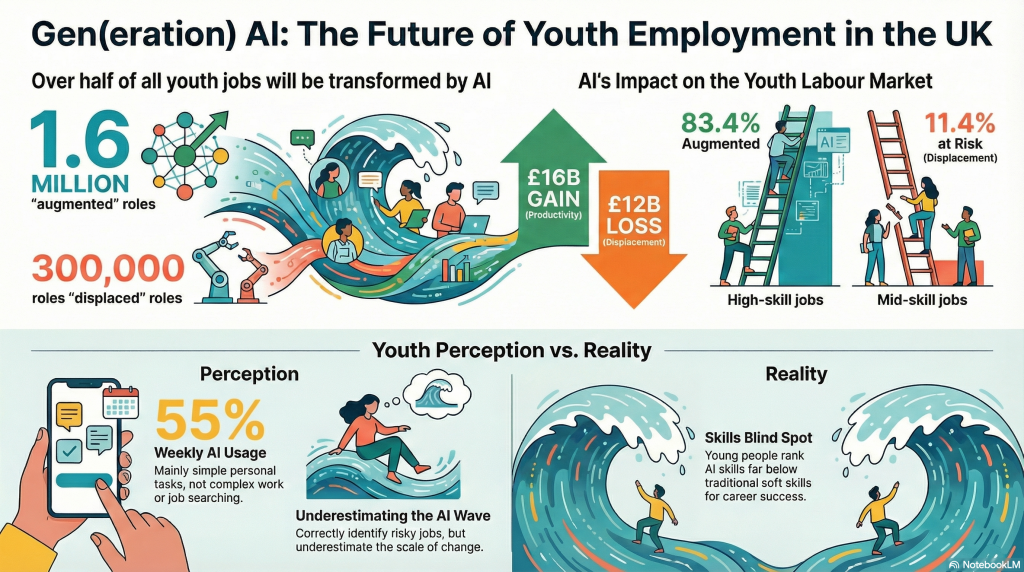
A new landmark report reveals a startling fact: 56% of jobs held by young people are about to be transformed by Artificial Intelligence, but not in the way you think. For a generation entering a workforce already shaped by economic instability, the headlines about AI often swing between dystopian visions of mass unemployment and utopian promises of a world without work, creating widespread anxiety.
Cutting through this noise is “Gen(eration) AI,” a groundbreaking analysis from The King’s Trust. It is the most detailed report to date focused specifically on how AI will alter the employment landscape for young people in the UK. Crucially, the report quantifies the economic stakes for the nation, revealing that billions of pounds hang in the balance based on how this generation is supported through the transition.
This article distills the report’s extensive findings into the five most surprising and impactful truths that every young person should understand. These are not predictions about a distant future; they are realities taking shape right now, and they reveal a story of opportunity that is far more common than the threat of outright replacement.
1. AI is far more likely to transform your job than take it.
The biggest fear surrounding AI is job replacement, but the report’s core finding directly challenges this narrative. A precise 56% of the roles currently held by young people are set to be impacted by AI, but the nature of that impact is overwhelmingly one of transformation, not elimination.
The numbers provide a clear picture:
• 46% of jobs are likely to be augmented, meaning AI will transform them to be more productive.
• Only 10% are at high risk of displacement, meaning they could be replaced entirely.
• 44% are likely to be insulated and largely unaffected by AI.
An “augmented” role is one where AI automates repetitive tasks, freeing up workers to focus on higher-value, strategic work. In contrast, a “displaced” role is one where such a large share of tasks can be automated that the job itself is at risk. The key takeaway is that the opportunity for reinvention far outweighs the risk of total automation.
This distinction is not just about individual careers; it represents a major economic crossroads for the UK. The report estimates that successfully augmenting these roles could inject £16 billion into the economy. Conversely, failing to support young people in displaced roles could result in a £12 billion loss in economic output. The stakes extend far beyond personal job security—they are a national economic imperative.
2. The biggest changes aren’t just happening in tech and finance.
When we think of AI’s impact, we often picture “knowledge economy” sectors. While industries like ICT and finance do have the highest proportion of jobs at risk, the report reveals a surprising truth: the single sector with the largest number of affected young workers is wholesale and retail.
The data shows that over 60,000 roles in wholesale and retail are at risk of being displaced, and over half a million could be augmented. This is because, as the report explains, young workers are “highly concentrated in sub-sectors that contain many jobs which involve many automatable tasks,” specifically citing roles like “shop assistants and cashiers.”
The critical implication here is that AI is not just a “white-collar” issue. It is actively transforming the very sectors that serve as the primary entry point into the labor market for millions of young people, making AI literacy a fundamental requirement across the entire economy.
3. There’s a dangerous gap between how AI will change work and how young people think it will change work.
Perhaps the report’s most alarming finding is a dangerous disconnect between reality and perception. While young people are good at identifying which jobs might be displaced by AI (like computer programmers), they “consistently underestimate the number of jobs AI is likely to transform across most sectors.”
The implication of this gap is profound. Many young people may not realize how crucial AI skills will be for their desired career path, even in roles that are not at risk of being eliminated. This is compounded by a sense of personal optimism; while young people are concerned about AI’s impact on their generation, they tend to be more optimistic about their own careers, suggesting a belief they can personally avoid the effects. This failure to recognize the scale of transformation has a direct and dangerous consequence: it leads young people to undervalue the very skills they now need most.
4. You’re probably undervaluing the one skill that’s getting a pay raise.
The perception gap leads directly to a skills gap. Polling data shows a significant disconnect between the skills young people prioritize and those the AI-driven economy is beginning to reward. Young people rank skills like “communication” and “problem solving” as highly important. In contrast, they rank “Using AI tools” much lower—it is just as likely to be seen as unimportant as it is important.
This perception is at odds with the report’s finding of an “emerging premium these skills are attracting in the labour market.” In other words, the ability to use AI tools effectively is already commanding higher wages, but young people have not yet recognized its value. Their views are “not yet aligned with the growing consensus that an AI transformed economy will require a mixture of technological and human centred skills.”
5. Almost everyone is using AI, but almost no one is getting trained.
A culture of proactive, self-directed learning is flourishing around AI, driven by a strong desire from young people to master these new tools—but it’s happening almost entirely in spite of a lack of institutional support. An incredible 55% of young people use AI tools at least weekly. The vast majority, however, are learning on their own.
The data is stark: 44% of young people say they figured out how to use AI for themselves, while only 4% received any training from their employer. This lack of formal guidance has a real consequence, as 53% of young people report “they feel like they are being left to figure out AI and its impact on their own.” There is a clear demand for more support, with 61% agreeing that employers should be providing it.
Conclusion: Your Future is Augmented, Not Automated
The message from the “Gen(eration) AI” report is clear: the AI transition is less about a threat of replacement and more about an opportunity for augmentation. For young people entering the workforce, the future is not automated—it is augmented. However, seizing this opportunity requires a realistic understanding of the changes ahead and a proactive approach to skill development. Closing the critical gaps in perception and training is the most urgent task for young people, educators, and employers alike.
As Julia Beaumont, Chief Technology and Programmes Officer at The King’s Trust, writes in the report’s foreword:
The choices we make now will determine whether AI becomes a driver of greater inequality or a source of great opportunity. Now that you know the real score, what’s the one skill you’ll start building today to thrive in an AI-augmented world?